Deepak Sengar · Published 28 July 2026 · Updated 12 August 2026· 19 min read
Types of SEO Explained: On-Page vs Technical vs Off-Page SEO in 2026
Confused by the types of SEO? Learn on-page vs off-page SEO, technical SEO checklist, and which to prioritise in 2026 for better rankings and AI search visibility.
Table of contents
- 01What Are the Types of SEO? A Clear Overview
- 02On-Page SEO vs Technical SEO: What's the Difference?
- 03What Is On-Page SEO?
- 04What Is Technical SEO?
- 05What Is Off-Page SEO?
- 06On-Page vs Technical vs Off-Page SEO: Full Comparison
- 07Which Type of SEO Should You Focus on First?
- 08On-Page SEO Checklist 2026 (Actionable)
- 09Technical SEO Checklist (Priority Order)
- 10Common Mistakes When Working with the Types of SEO
- 11Expert Tips for Balancing On-Page, Technical & Off-Page SEO in 2026
- 12Essential Tools & Resources for Each Type of SEO
- 13How the Types of SEO Are Evolving with AI Search (2026 Trends)
- 14Mini Case Study: Fixing One Pillar at a Time
- 15Future Outlook: The Types of SEO Beyond 2026
- 16Final Thoughts – Building a Complete SEO Strategy
- 17Key Takeaways
- 18Frequently Asked Questions
- 19Ready to Build a Balanced SEO Strategy?
Quick answer: Three types of SEO exist. On-page SEO is where you make optimizations in your website directly by optimizing content, titles, headings, and internal links. Technical SEO is all about having the proper structure of your website to enable search engines and AI crawlers to be able to see and process your site – loading speed, mobile-friendliness, and structure. Off-page SEO refers to the authority gained from outside your site – backlinks, mentions, and reviews.
You've probably run into these three terms before — on-page, technical, and off-page — tossed around like everyone in the room already gets it. Most beginners just nod along, secretly lost, and end up building a strategy around whichever one clicked for them first. That's usually the real reason rankings stall out. Not laziness. Not lack of effort. Just an incomplete picture.
So here's the honest version. The types of SEO aren't rival strategies you choose between. They're three gears in the same machine. Skip one, and the other two can only carry you so far — you'll hit a ceiling and won't quite know why.
This guide is written for exactly where you're standing right now: you want plain definitions, real comparisons, and somewhere to actually start. We'll go through what on-page, technical, and off-page SEO mean, how they differ, and why all three genuinely matter — especially in 2026, with Google's AI Overviews, ChatGPT, Gemini, and Perplexity changing how content even gets discovered in the first place. By the end you'll have working checklists, a way to prioritize your time, and a realistic sense of where to put your energy first.
What Are the Types of SEO? A Clear Overview
In plain terms: SEO splits into three main buckets, and each one covers a different slice of what makes a website rank.
On-page SEO is everything you control directly on your pages — your content, your titles, your headings, your internal links.
Technical SEO is the plumbing behind all of it — whether search engines, and increasingly AI systems, can even reach your site, crawl it, and make sense of what's there.
Off-page SEO is what happens away from your website but still shapes how trustworthy you look — backlinks, mentions, reviews, reputation.
None of this appeared overnight, by the way. Early search engines cared mostly about keyword matching on the page itself. Once sites got good at gaming that, Google leaned harder on off-page signals like backlinks to gauge real trust. And as the web got messier — JavaScript everywhere, mobile-first everything, AI crawlers trying to parse pages that weren't built with them in mind — technical SEO became its own thing entirely, not just a footnote.
Here's an analogy that tends to land with beginners: think of your website as a shop. On-page SEO is your signage, your product displays, how clearly you explain what you're actually selling. Technical SEO is the building — the foundation, the doors, the lighting, whether customers (and delivery trucks) can get in and move around without tripping over something. Off-page SEO is your reputation around town: word of mouth, reviews, whether other respected businesses vouch for you.
Why does this matter? Because Google — and now AI answer engines — judge your site as a whole. A beautiful shop nobody can find fails. So does a well-located building with confusing signage. Different failure, same result.
The Three Core Types of SEO at a Glance
On-page SEO — optimizing content and structure directly on your pages: titles, headings, keyword placement, internal links, images.
Technical SEO — making sure search engines and AI crawlers can find, render, and index your site: speed, mobile-friendliness, crawlability, structured data.
Off-page SEO — building authority and trust through signals outside your site: backlinks, brand mentions, reviews, social proof.
On-Page SEO vs Technical SEO: What's the Difference?
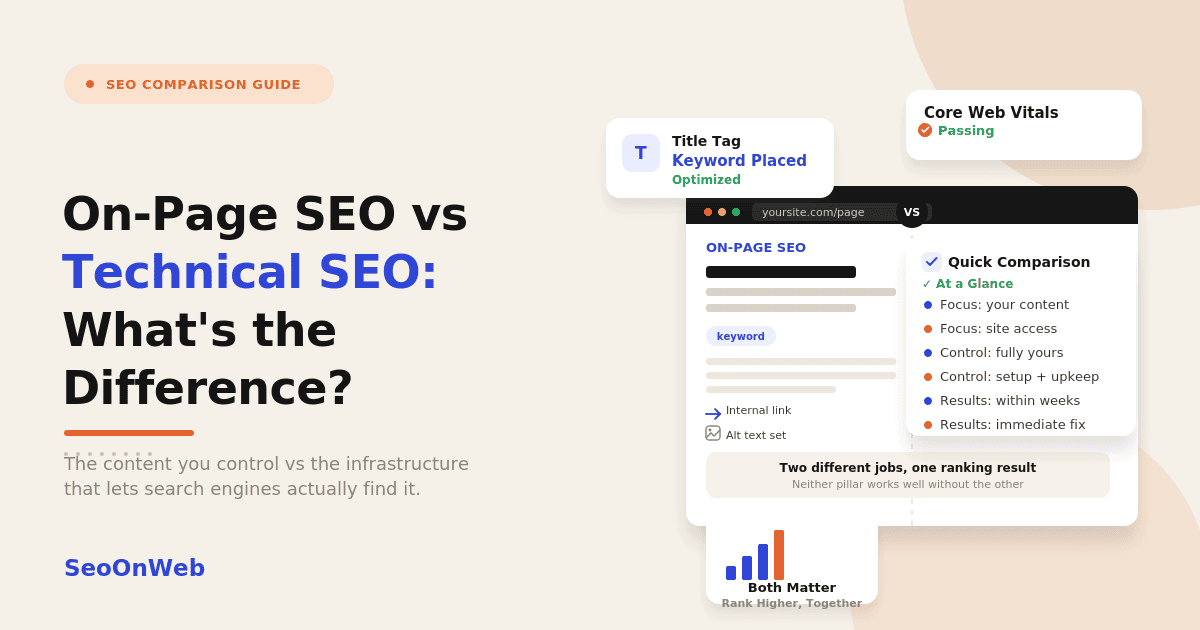
This is the comparison people search for most, so it's worth answering directly before getting into the individual pillars.
On-page SEO is what you actively write and structure on a page — the words, the titles, the internal links. It's about relevance: does this page clearly deserve to rank for what it's about? Technical SEO is the infrastructure question underneath all of that — can search engines and AI crawlers even reach, render, and index the page in the first place? It's about accessibility, not content.
Put simply: on-page SEO is about what your page says. Technical SEO is about whether anyone — human or crawler — can actually get to it and read it correctly. A page can be perfectly written and still rank nowhere if the technical foundation is broken, and a technically flawless site with thin, generic content won't out-rank real competitors either.
On-Page vs Technical SEO: Full Comparison Table
Factor | On-Page SEO | Technical SEO |
Focus | Content and on-site elements | Crawl, index, performance, structure |
Control | Full | Full (mostly one-time setup plus ongoing monitoring) |
Main Goal | Relevance and clarity | Accessibility and usability |
Speed of Results | Weeks | Immediate once fixed |
Beginner Difficulty | Easiest | Medium |
Key Tools | Keyword research tools, on-page optimizers | Screaming Frog, Google Search Console, PageSpeed Insights |
AI Search Impact | High — directly quotable content | Critical — determines access and comprehension |
Key differences at a glance
On-page SEO happens on your own pages and is fully within your control; technical SEO happens at the site-infrastructure level.
On-page SEO is about relevance and clarity; technical SEO is about crawlability and accessibility.
On-page SEO includes titles, headings, and content; technical SEO includes site speed, indexing, and structured data.
What Is On-Page SEO?
On-page SEO covers every element you can touch directly on a single page — the words, the layout, the metadata, the internal wiring. The whole point is relevance and clarity: making it obvious to a human reader and to a search engine (or AI model) what your page is actually about, and why it deserves to rank for it.
It's usually the right place for beginners to start, for a pretty simple reason — you don't need anyone's permission to fix it. No outreach emails, no waiting around for someone to link to you. Just you, your content, and your editing cursor.
Key Elements of On-Page SEO
Title tags — the clickable headline in search results; your primary keyword should sit near the front, phrased like a human wrote it.
Meta descriptions — the short blurb under your title. Doesn't move rankings directly, but it absolutely moves click-through rate.
Headings (H1–H4) — a logical structure that organizes your content for readers and helps search engines (and AI tools) get the shape of your page at a glance.
Content quality and depth — genuinely thorough content that answers the question, not padded-out filler just to hit a word count.
Keyword placement and semantic relevance — your target keyword used where it makes sense, backed up by related terms Google expects to see nearby. If you're not sure where those keywords should come from in the first place, we've got a full breakdown of how to find the right keywords without paying for a tool.
Internal linking — pointing to related pages on your own site, which helps both readers and crawlers understand how your content connects.
Image optimization — real alt text, compressed files, modern formats like WebP.
URL structure — short, readable URLs instead of a jumble of parameters.
On-page schema — structured data that marks up what type of content you've actually published.
Readability and formatting — short paragraphs, bullet points, tables, visual breaks. Nobody wants to read a wall of text, and honestly, neither do crawlers.
On-Page SEO Checklist 2026

Primary keyword appears naturally in the title tag, URL, H1, and first 100 words
Meta description written to earn clicks, not just describe the page
Heading structure follows a clean, logical hierarchy (one H1, organized H2s and H3s)
Content directly and quickly answers the core search intent before adding extra depth
At least one clear "answer block" — a tight 2–4 sentence direct answer — near the top of key sections, for AI Overview and featured snippet eligibility
Semantic keywords and related entities woven in naturally, not force-fit
Internal links to 3–5 genuinely relevant related pages
All images have descriptive alt text and are properly compressed
E-E-A-T signals present: author credentials, credible citations, real examples
FAQ section included, structured for direct extraction by AI systems
Schema markup implemented and validated
Benefits of Strong On-Page SEO
Good on-page work tends to pay off faster than the other two — sometimes within weeks, since you're not waiting on anyone else's cooperation. It also lifts click-through rate directly (a sharp title and meta description alone can move the needle even before a ranking shifts), improves engagement metrics like time-on-page, and gives your content a real shot at showing up in AI-generated answers. These systems just favor content that's clearly organized and directly answered. Makes sense when you think about it.
Great SEO isn't about tricks — it's about being genuinely useful, and making sure Google can tell.
What Is Technical SEO?
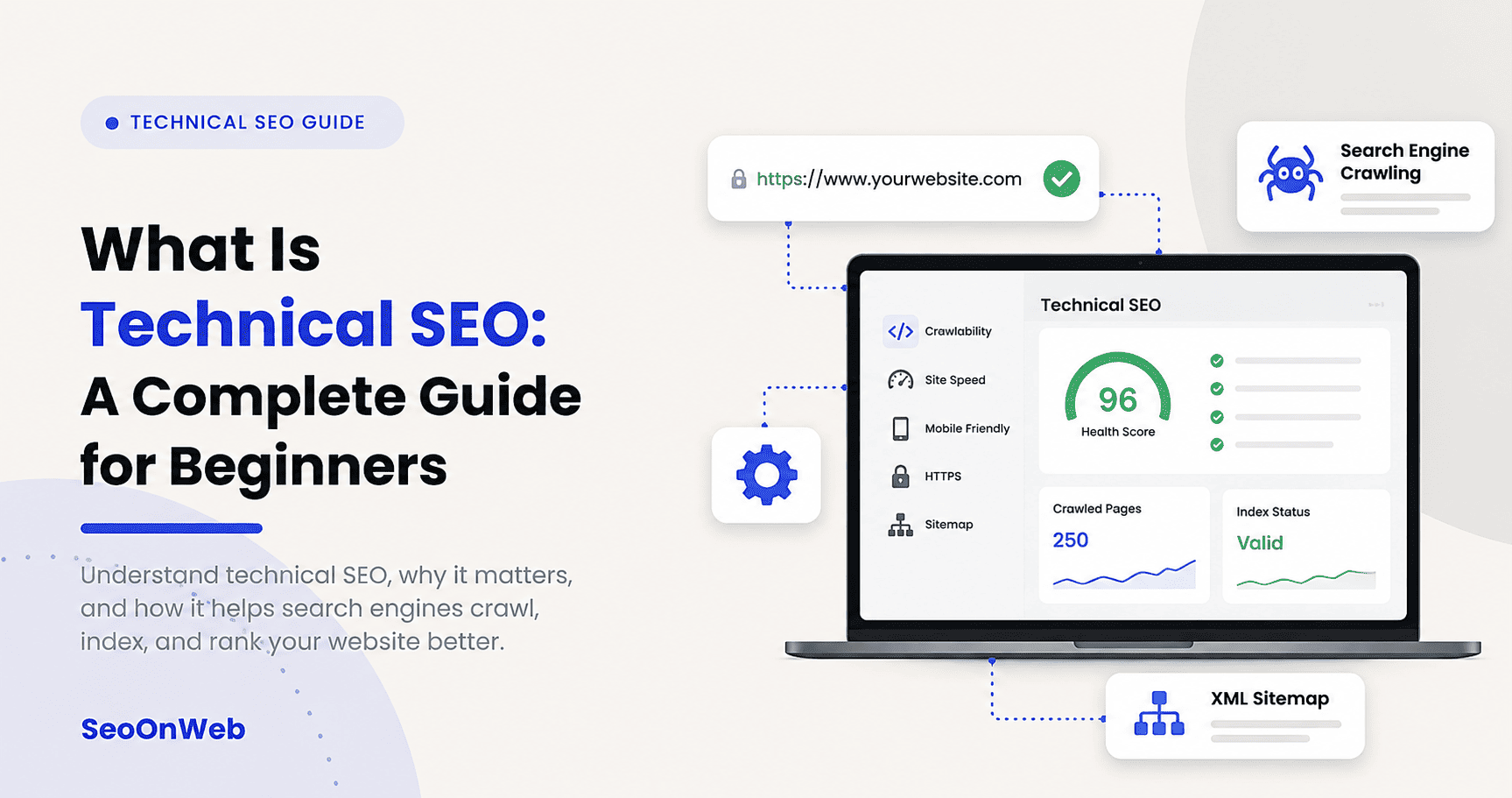
Technical SEO is the foundation everything else sits on top of. It's what decides whether search engines — and now AI crawlers behind tools like ChatGPT and Perplexity — can actually get into your site, render it properly, index it, and understand what's there.
This is not the same thing as "content work," and the distinction matters. You could write the best article on the entire internet about a topic, and if your site blocks crawlers or loads like molasses or falls apart on mobile, nobody ever sees how good it is. Technical problems don't just weaken your other efforts. They can wipe them out completely.
Core Components of Technical SEO
Crawlability and indexability — a robots.txt file that isn't accidentally blocking things, an updated XML sitemap, correct canonical tags, no stray noindex tags hiding pages you actually want ranked.
Site speed and Core Web Vitals — Largest Contentful Paint (LCP), Interaction to Next Paint (INP), and Cumulative Layout Shift (CLS). These are the metrics Google uses to judge real-world page experience.
Mobile-friendliness — a genuinely responsive design, since Google indexes mostly off the mobile version of your site now.
HTTPS and security — a valid SSL certificate, no mixed-content warnings popping up.
Structured data and schema — JSON-LD markup that tells both search engines and AI systems exactly what's on each page. If you haven't done this yet, adding schema markup to your pages is one of the more approachable technical wins available, even without a developer.
Site architecture and internal linking structure — a logical, shallow structure so your most important pages aren't buried five clicks deep.
JavaScript rendering issues — making sure dynamically loaded content is actually visible to crawlers and not hidden behind rendering they can't handle.
Duplicate content and pagination — proper canonicalization so search engines aren't left guessing which version to rank.
International SEO and hreflang — if you're serving multiple regions or languages, signaling clearly which version belongs where.
Technical SEO Checklist
Confirm robots.txt isn't accidentally blocking important pages
Submit and regularly update your XML sitemap in Google Search Console
Fix any crawl errors, broken redirects, or 404s
Run Core Web Vitals through PageSpeed Insights and address failing metrics
Confirm full mobile-friendliness with Google's Mobile-Friendly Test
Verify HTTPS is active site-wide with no mixed-content issues
Implement and validate structured data with the Rich Results Test
Check for duplicate content and correct canonical tags
Confirm JavaScript-rendered content is actually crawlable
Review site architecture for a clean, shallow click-depth structure
Set up ongoing monitoring — technical SEO is a one-time setup plus continuous maintenance, not a single fix
How Technical SEO Supports AI Search Engines
Here's the thing people miss: AI Overviews, ChatGPT, Gemini, Perplexity — all of them need to actually access and parse your content before they can cite it. A technically broken site is just as invisible to these systems as it is to old-school Googlebot. Clean structured data, fast load times, content that renders properly — none of that's just for classic rankings anymore. It directly decides whether an AI tool can confidently pull information from your site and credit you for it.
What Is Off-Page SEO?
Off-page SEO is about the authority and trust signals that build up away from your own website — the part of your reputation you can nudge but never fully control.
It's grown well past just collecting backlinks. Links still matter, sure, but off-page SEO today also covers how often your brand gets mentioned (linked or not), what your reviews look like, and whether you show up consistently and credibly across the web.
Here's the key difference from on-page and technical work: this stuff is earned, not built. You can't just bolt on trust the way you'd add a meta tag. It builds up slowly, through actual reputation, relationships, and visibility over time.
Main Off-Page SEO Activities
High-quality backlinks — links from relevant, respected sites vouching for your content.
Brand mentions and digital PR — press coverage that puts your name in front of people who've never heard of you.
Online reviews and reputation — Google reviews, industry review sites, and how you handle the negative ones.
Local citations (NAP consistency) — matching name, address, and phone details across directories, especially important for local businesses. If that's you, our local SEO checklist walks through the full setup, not just the citation piece.
Social signals and community engagement — real participation where your audience actually hangs out, not just posting into the void.
Influencer and expert collaborations — partnerships that borrow credibility and reach.
Guest posting and thought leadership — contributing content that's genuinely worth reading to respected industry sites.
Unlinked brand mentions — getting talked about even without a clickable link, which search engines increasingly treat as a trust signal on its own.
Off-Page SEO Beyond Backlinks
In the AI era, non-link signals are pulling more weight than they used to. Entity recognition — where search engines and AI models understand your brand as a real, consistent thing rather than just a domain name — matters more alongside traditional links. Co-citations (getting mentioned near respected names in your field, even without a link) and steady brand authority across the web are turning into real trust signals AI systems lean on when deciding whether to cite you or not.
Benefits of Off-Page SEO
Solid off-page work builds domain authority over time, strengthens the trust signals that both traditional rankings and AI systems rely on, and often brings in genuine referral traffic straight from whoever's linking or talking about you. It also builds broader brand visibility that outlasts any single search result.
On-Page vs Technical vs Off-Page SEO: Full Comparison
It's easy to see why people mix these up — the terms overlap, and plenty of tasks bleed across more than one category at once. Here's a side-by-side to clear it up for good.
Factor | On-Page SEO | Technical SEO | Off-Page SEO |
Focus | Content and on-site elements | Crawl, index, performance, structure | Authority and trust signals |
Control | Full | Full (mostly one-time setup plus ongoing monitoring) | Limited — largely earned |
Main Goal | Relevance and clarity | Accessibility and usability | Authority and credibility |
Speed of Results | Weeks | Immediate once fixed | Months |
Beginner Difficulty | Easiest | Medium | Hardest |
Key Tools | Keyword research tools, on-page optimizers | Screaming Frog, Google Search Console, PageSpeed Insights | Ahrefs, Semrush, brand monitoring tools |
AI Search Impact | High — directly quotable content | Critical — determines access and comprehension | High — trust and entity signals |
The thing this table really drives home: these aren't rival priorities. They're layers, stacked on top of each other. Different focus, different timelines, different tools — all feeding into the same result.
How the Three Types of SEO Work Together
A reasonable order looks like this: sort your technical foundation first, so crawlers can actually get in and understand what you've built. Then build strong on-page relevance, so all that access actually translates into topical authority. Then let off-page trust stack on top of both.
Picture two sites in the same niche. One's got genuinely great content but a slow, tangled site and barely any backlinks — it plateaus, because good writing can't fix a technical wall or a total lack of outside validation. The other's got a lean, fast site, decent content, and a handful of genuinely relevant backlinks — it climbs, steadily, because all three pillars are pulling the same direction. Balance beats brilliance-in-isolation, almost every time.
Consistency beats cleverness. Publish, measure, refine, repeat — that's the whole game.
Which Type of SEO Should You Focus on First?
If you're just starting, on-page SEO is the natural entry point. It's fully in your hands, it's the fastest to pick up, and you'll usually see movement reasonably quickly.
That said — and this really does depend on where you're starting from:
Brand-new site — nail the core technical setup first (indexability, mobile-friendliness, basic speed), then build out on-page content, then start earning off-page authority once you've actually got something worth linking to.
Existing site with stalled traffic — run a technical audit before anything else. If you're in this position right now, it's worth taking ten minutes to run through the most common reasons a site fails to rank before you touch anything else. It's shockingly common to find great content quietly held hostage by a crawl error or a bad canonical tag or just a slow server nobody ever checked.
Competitive niche — you'll probably need to invest in off-page authority sooner rather than later. On-page quality alone often can't out-muscle established competitors with a decade of backlinks behind them.
If you're solo or running a tiny team, it usually makes sense to handle on-page and the basic technical stuff yourself, then bring in outside help once you're ready to seriously chase off-page growth — that pillar tends to eat the most time and demand relationships you don't build overnight.
Recommended Learning & Implementation Order for Beginners
On-page SEO first — build the habit of writing content that's genuinely useful and well organized.
Technical basics next — learn to check indexability, speed, and mobile-friendliness so nothing's quietly sabotaging your content.
Off-page SEO last — once you've got strong content and a solid technical base, start earning links, mentions, and reviews that compound over time.
On-Page SEO Checklist 2026 (Actionable)
Here's the expanded version you can actually copy and use:
Target keyword in title, URL, H1, and opening paragraph
Compelling meta description written for clicks
Clean heading hierarchy with genuine subtopic organization
Direct, answer-first structure for key questions (crucial for AI Overview extraction)
Comprehensive coverage of the topic — genuinely more complete than top-ranking competitors
Semantic keyword and related-entity coverage, not just repeating one exact phrase over and over
E-E-A-T signals: visible author expertise, credible outbound citations, real examples
Internal links to relevant supporting content
Optimized images with descriptive alt text
FAQ section addressing real, commonly searched questions
Schema markup implemented correctly
Content reviewed for readability — short paragraphs, scannable formatting, no unnecessary fluff
Technical SEO Checklist (Priority Order)
From critical to important, along with how often each one actually needs your attention:
Crawlability and indexability (one-time setup, recheck after any major site change) — robots.txt, sitemap, canonicals
Mobile-friendliness (one-time setup, periodic review) — responsive design confirmed across devices
Core Web Vitals (ongoing monitoring) — LCP, INP, CLS within Google's thresholds
HTTPS and security (one-time setup, periodic certificate check) — no mixed-content warnings
Structured data (per new content type, validated regularly) — schema implemented and error-free
Site architecture (reviewed during any redesign) — logical, shallow structure
JavaScript rendering (checked when adding dynamic features) — content genuinely crawlable
Duplicate content and pagination (ongoing monitoring) — correct canonical usage
Common Mistakes When Working with the Types of SEO
Treating the three types in isolation, instead of one connected system.
Over-optimizing on-page content while ignoring technical foundations — polishing an article on a site crawlers can barely reach.
Chasing low-quality backlinks for sheer volume instead of relevance and real authority.
Neglecting mobile performance and Core Web Vitals, assuming content alone will carry the rankings.
Writing purely for keywords instead of actual search intent and content an AI system can cleanly extract.
Ignoring entity and brand signals in off-page work and fixating only on link counts.
Not monitoring after changes — assuming a fix worked instead of actually checking. This is also where keeping your content on a regular refresh cycle pays off — a lot of "it stopped working" moments are really just content quietly going stale.
Assuming technical SEO is "set and forget", when really it needs revisiting as your site grows and changes.
Expert Tips for Balancing On-Page, Technical & Off-Page SEO in 2026
Build E-E-A-T signals across all three pillars, not just in your writing — visible expertise on the page, a technically trustworthy site (fast, secure, well-structured), and genuine authority off-page all reinforce each other.
Structure content for both traditional rankings and AI citation at the same time — clear headings, direct answers, organized lists serve both audiences without extra work.
Run regular technical health checks. Don't treat your last audit as permanent — sites drift out of shape as they grow, quietly, without anyone noticing.
Prioritize quality over quantity in link building and brand mentions. A handful of genuinely relevant, respected sources beats a pile of low-value ones every time.
Use your actual data — Search Console, analytics, rank trackers — to figure out which pillar is really lagging, instead of guessing based on whatever feels most urgent that week.
Align your SEO work with real business goals (calls, leads, sales), not vanity metrics like raw traffic or keyword counts that don't pay the bills.
Essential Tools & Resources for Each Type of SEO
SEO Type | Free Tools | Paid / Advanced Tools |
On-Page | Google Search Console, Google Keyword Planner | Surfer SEO, Clearscope |
Technical | Google PageSpeed Insights, Google Search Console | Screaming Frog, Sitebulb |
Off-Page | Google Alerts | Ahrefs, Semrush, Moz |
For beginners flying solo, a decent free stack — Search Console, PageSpeed Insights, Google Alerts — covers a genuinely useful baseline. As you scale up, one paid all-in-one platform like Ahrefs or Semrush usually delivers more value than juggling five narrow single-purpose tools.
How the Types of SEO Are Evolving with AI Search (2026 Trends)
Google's AI Overviews, plus ChatGPT, Gemini, and Perplexity, are reshaping how all three pillars actually work in practice. The overall shift is toward what people are calling Answer Engine Optimization (AEO) and Generative Engine Optimization (GEO) — building your site so it's not just ranked, but genuinely cited and quoted by these systems.
We cover the practical side of this in a dedicated guide on getting cited by ChatGPT, Gemini, and Perplexity, if you want to go deeper than the overview here.
Structured data, clear entity signals, and real brand authority are growing more important across the board. Meanwhile, the content formats AI systems clearly prefer — tight lists, comparison tables, direct definitions, well-built FAQs — are becoming less of a nice-to-have and more of a baseline requirement.
Does Technical SEO Still Matter with AI Overviews?
Yes. Honestly, maybe more than before. AI systems still need to access, render, and parse your content before they can cite it, so accessibility and clean structured data matter just as much — arguably more — than they ever did for plain old crawling.
How Off-Page SEO Has Changed for AI Search Engines
Brand mentions, co-citations, reviews, broader authority signals — all of it carries real weight now beyond just counting backlinks. AI systems seem to weigh how consistently and credibly a brand gets talked about across the web, not just how many links happen to point at it.
Mini Case Study: Fixing One Pillar at a Time
Picture a small local service business. Genuinely good content, but traffic's flat. A quick technical audit turns up slow mobile load times and a handful of pages accidentally blocked by an old robots.txt rule someone forgot about years ago. Fixing just those two things — nothing else touched — leads to a solid jump in indexed pages and a real bump in mobile rankings within a few weeks.
Encouraged, they move on to on-page gaps next. Thin service pages get rewritten with actual depth, clear answer blocks, proper internal linking. Traffic keeps climbing over the following couple months.
Only after that do they touch off-page work — a few genuine local citations, a handful of earned reviews, one solid feature in a local business publication. That's the piece that finally pushes them into the map pack and keeps them there. This pattern holds up in pretty much every real case like this: fix the pillars in the right order, and you get faster, sturdier results than throwing effort at all three at once and hoping something sticks.
Future Outlook: The Types of SEO Beyond 2026
Expect these three pillars to keep blending together rather than staying neatly boxed off. Experience, expertise, and brand-level trust will probably carry even more weight as AI systems get sharper at telling genuine authority apart from surface-level polish. Multimodal and conversational search — where people ask follow-up questions instead of typing one isolated query — will likely reward sites that are technically clean, genuinely thorough, and credibly trusted, all three at once. A balanced approach across on-page, technical, and off-page work stays the safest long-term bet, mostly because it doesn't crumble the moment one algorithm shifts.
Final Thoughts – Building a Complete SEO Strategy
So, to recap: on-page SEO is what you write and structure on your own pages. Technical SEO is the foundation that makes your site accessible and understandable in the first place. Off-page SEO is the trust and authority you earn beyond your own site. None of the three does much on its own — they multiply each other when you actually handle them together.
Not sure where to start? Run an honest audit of your weakest pillar first. For most beginners, that's a technical foundation quietly holding back content that's actually pretty good. Mastering all three types of SEO is a skill that compounds — the sooner you build a balanced base, the more every piece of content and every earned link ends up paying off down the road.
Key Takeaways
The three types of SEO — on-page, technical, and off-page — are complementary, not competing strategies
On-page SEO is the easiest starting point since it's fully within your control
Technical SEO is the foundation that determines whether anything else you do can even be seen
Off-page SEO is earned trust and authority, and it typically takes the longest to build
AI Overviews, ChatGPT, Gemini, and Perplexity all depend on clean technical access and clearly structured content to cite you accurately
A balanced approach across all three pillars consistently outperforms excelling at just one
Frequently Asked Questions
What is the difference between on-page and off-page SEO?
What is the difference between on-page and technical SEO?
What is technical SEO and how is it different from on-page SEO?
Is technical SEO part of on-page SEO or a separate category?
Which is more important: on-page, off-page, or technical SEO?
Which type of SEO should beginners learn first?
Can you rank #1 with only on-page SEO and no backlinks?
What are some examples of on-page SEO techniques?
What are some examples of off-page SEO activities besides backlinks?
What does a technical SEO audit actually check?
Does technical SEO still matter now that Google uses AI Overviews?
How has off-page SEO changed with AI search engines like ChatGPT and Perplexity?
Do I need to hire separate experts for on-page, off-page, and technical SEO?
More from the blog
All posts
Top 8 SEO Tips for Beginners in 2026
Learn the top 8 SEO tips for beginners in 2026. Discover keyword research, on-page SEO, technical SEO, AI search optimization, and proven strategies to rank higher on Google.
Google Algorithm Update 2026: Key Changes & Recovery Tips
Discover what changed in the Google algorithm update 2026 and how to recover rankings after a drop. Core updates, spam updates, and a practical SEO recovery checklist.
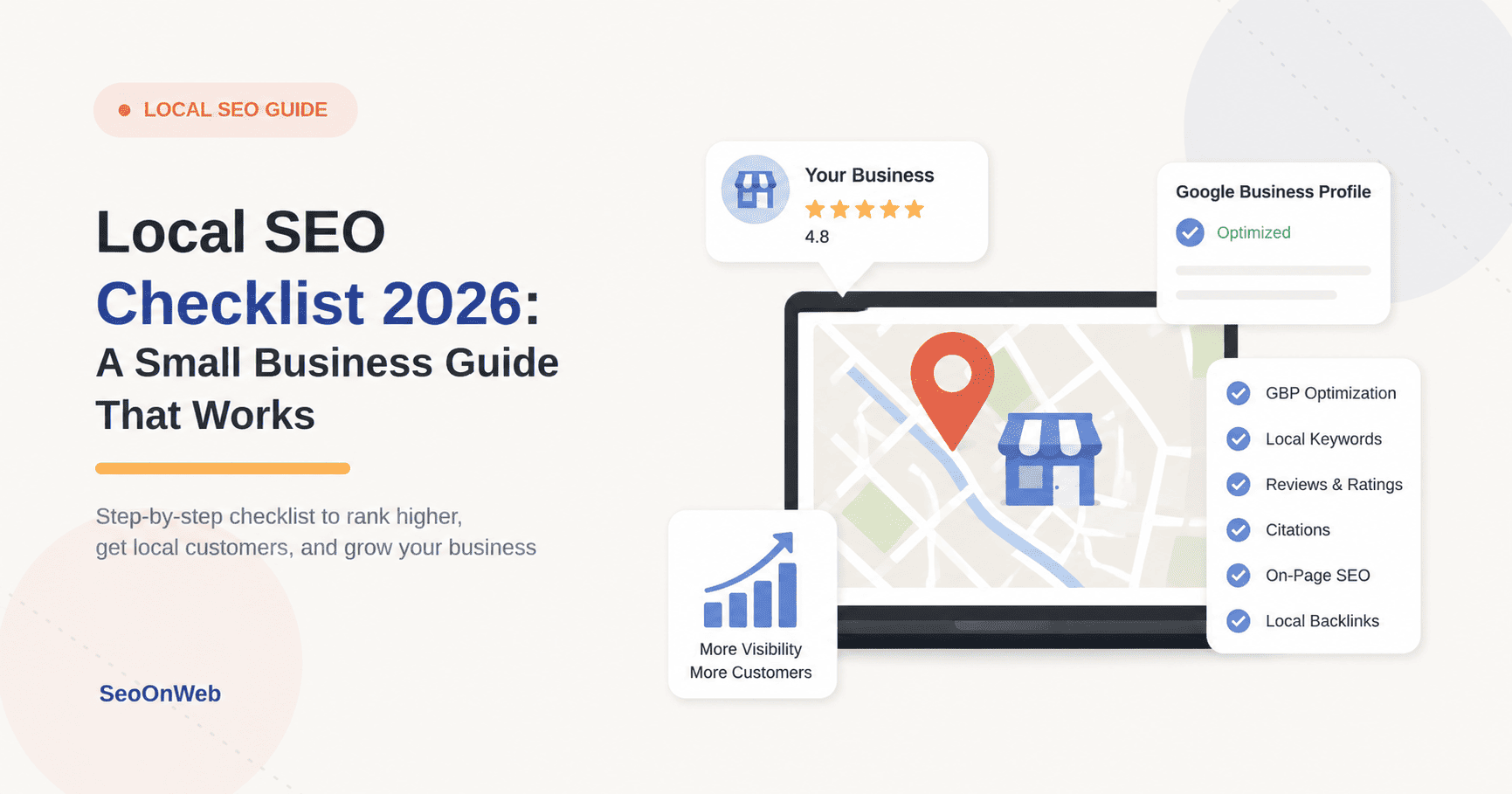
Local SEO Checklist for Small Businesses
Follow this 2026 local SEO checklist to optimize your Google Business Profile, build citations, earn reviews, and rank higher on Google Maps.
Let's talk
Ready to Build a Balanced SEO Strategy?
Understanding the types of SEO is the easy part. Actually auditing your own site and figuring out what to fix first — that's where most people get stuck. If you'd like a second set of eyes on where your site's weakest pillar really is, we're happy to run a fre…

Written by
Deepak Sengar
SEO Expert · Founder, SeoOnWeb
Deepak Sengar is an SEO specialist with 3+ years of experience across on-page SEO, technical SEO, AI Search Optimization (AIO), Answer Engine Optimization (AEO), Generative Engine Optimization (GEO), keyword research, and content optimization. He holds a Bachelor of Business Administration (BBA) from Bundelkhand University. He most recently worked as an SEO Executive at College Drishti, a Delhi-based education consultancy, from July 2025 to May 2026, where he led SEO strategy to grow organic visibility and traffic for undergraduate (UG) and postgraduate (PG) admissions content. Today, through SeoOnWeb, he helps businesses build ranking strategies rooted in the same on-page, technical, and off-page fundamentals.
More about Deepak