Deepak Sengar · Published 2 August 2026· 15 min read
Local SEO Checklist for Small Businesses
Follow this 2026 local SEO checklist to optimize your Google Business Profile, build citations, earn reviews, and rank higher on Google Maps.
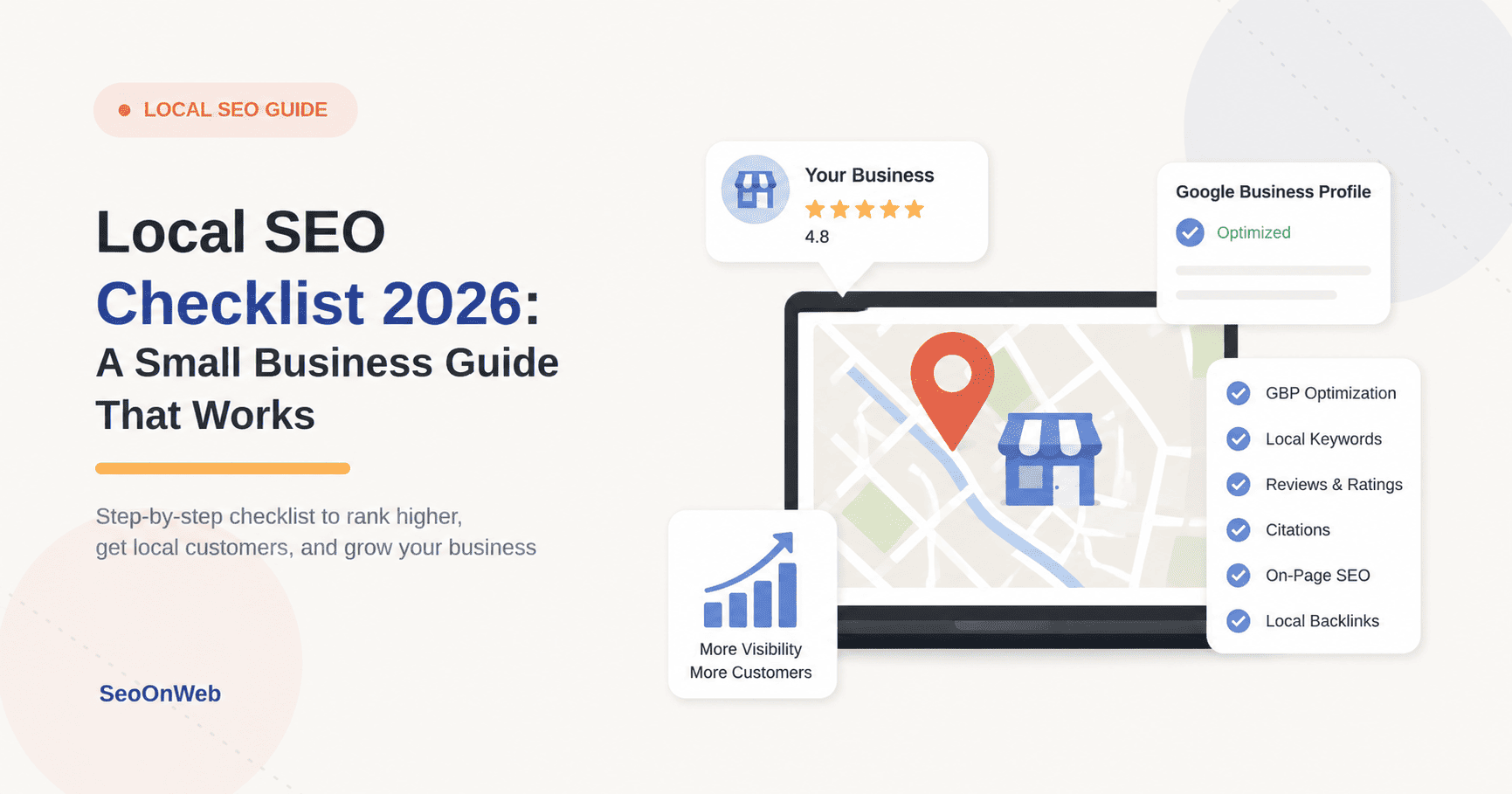
Table of contents
- 01What Is Local SEO?
- 02Why Local SEO Matters for Small Businesses
- 03Key Components of Local SEO
- 04The Complete Local SEO Checklist
- 05Local SEO vs. Traditional SEO: What's the Difference?
- 06Common Local SEO Mistakes to Avoid
- 07Expert Tips for Ranking #1 Locally
- 08Tools & Resources for Local SEO
- 09Latest Trends in Local SEO (2024–2026)
- 10Future Outlook: What's Next Beyond 2026
- 11Final Thoughts
- 12Frequently Asked Questions
Picture this: someone in your city just typed "plumber near me" into Google. Three businesses show up in the map with photos, star ratings, and a "Open Now" tag. Your business isn't one of them — even though you've been in business for eight years and do great work.
That's the reality for a lot of small business owners. You can be the best at what you do and still lose the customer before they ever see your website, simply because your local SEO isn't dialed in.
This local SEO checklist walks you through exactly what to fix, in the order that matters most. No fluff, no jargon you have to Google separately — just the steps that actually move the needle on Google Maps and in local search results, updated for how Google and AI search tools work in 2026.
By the end, you'll know how to optimize your Google Business Profile, build the right citations, collect reviews the right way, and set your website up to rank on Google Maps and in the local map pack — even if you've never touched SEO before.
What Is Local SEO?
Local SEO is the process of optimizing your online presence so your business shows up when people search for products or services near them — think "coffee shop near me" or "emergency electrician in Leeds."
It's a specific branch of SEO, and it works a little differently than the SEO you'd use for a national or global website.
How it differs from traditional SEO:
Traditional SEO chases broad keyword rankings across the whole country or world.
Local SEO is built around geography — your city, your neighborhood, even your specific street.
Google leans on different signals for local results: your Google Business Profile, your business's name, address, and phone number (often shortened to NAP), how close you are to the searcher, and what your reviews say about you.
When someone searches "bakery in Manchester" or "dentist near me," Google isn't just looking at your website. It's cross-referencing your Google Business Profile, your citations across the web, your reviews, and your on-page content to decide who deserves a spot in the local 3-pack — the block of three map listings that shows up above the regular search results.
If you only remember one thing from this section, make it this: local SEO is about proving to Google, over and over, in a dozen small ways, that your business is real, current, and relevant to a specific place.
Why Local SEO Matters for Small Businesses
It's easy to assume local SEO is a "nice to have." The numbers say otherwise.
Nearly half of all Google searches carry local intent, and a large share of people who search for a business on their phone visit that business within a day. That's not window-shopping — that's someone actively ready to buy, call, or walk through your door.
Here's why that matters so much for a small business specifically:
Trust is built before anyone calls you. Most consumers read online reviews before choosing a local business, and a well-optimized Google Business Profile does a lot of that trust-building on autopilot.
Visibility drives revenue directly. Most people never scroll past the first page of local results. If you're already asking why isn't my business showing up on Google Maps, the fixes below are the fastest place to start.
Most competitors are still doing this badly. A surprising number of small businesses have an unclaimed, half-filled-out, or outdated Google Business Profile. That's your opening.
Completeness alone changes outcomes. Google's own data suggests that businesses with a complete profile are viewed as noticeably more reputable and are far more likely to be visited than businesses with incomplete ones.
Mobile and voice search keep growing. A large share of consumers look up local businesses on their phones every week, and voice assistants are increasingly the way people ask "who's open near me right now."
In short: local SEO isn't a marketing extra. For most small businesses, it's the difference between a phone that rings and one that doesn't.
Key Components of Local SEO
Local SEO isn't one task — it's a handful of interconnected pieces that all reinforce each other. Get one wrong and it can quietly undercut the rest. Here's every piece you need to have in place.
Google Business Profile Optimization
If you do nothing else on this list, do this. Your Google Business Profile (GBP) — formerly Google My Business — is the single biggest lever for local rankings and the main reason you show up in the map pack at all.
A complete, verified, and actively maintained profile tells Google (and your customers) that you're a real, trustworthy business worth recommending.
Checklist:
Claim and verify your Google Business Profile at business.google.com. Verification usually happens by postcard, phone, or email, depending on your business type.
Choose the most specific primary category available — "Emergency Plumber" beats plain "Plumber" if it fits — then add two or three secondary categories for the other services you offer.
Write a clear, keyword-rich business description (you get up to 750 characters). Say what you do, who you serve, and where — naturally, not stuffed with repeated phrases.
Lock in NAP consistency. Your business name on GBP should be your actual legal/trading name — no keyword stuffing like "Best Plumber Manchester Ltd" if that's not your real name — and your address and phone number need to match your website exactly, right down to abbreviations.
Upload real, high-quality photos: a clear logo, a cover image, and at least ten photos of your team, your work, and your location. Businesses with a strong photo library consistently get more profile views and more calls.
Post regularly. Use Google Posts weekly for offers, news, or tips, answer every question in the Q&A section, keep your hours current (including holidays), and check monthly for spammy edits or outdated info.
Expert tip: Treat every single field in your GBP dashboard as prime real estate. Attributes like "women-led" or "wheelchair accessible," service lists, and fresh posts all give Google more reasons to match you to relevant searches — and give customers more reasons to trust you before they've even visited your site.
On-Page Local SEO (Your Website)
Your Google Business Profile gets you noticed. Your website has to back it up. Google actively cross-checks the two, so inconsistency between them is one of the fastest ways to quietly tank your local rankings.
Checklist:
Display your NAP on every page — usually in the header or footer — and make sure the formatting matches your GBP exactly.
Add your city and state to title tags and headings. "Emergency Plumber in Manchester | ACME Plumbing" tells Google exactly where you operate, and it tells the searcher the same thing at a glance.
Build dedicated pages for each service and location combination, rather than one generic page trying to cover everything. If you serve three cities, each city deserves its own page with genuinely different, locally relevant content — not the same paragraph with the city name swapped out.
Write content that actually answers customer questions, using real neighborhood names and local landmarks where it fits naturally. For the process of finding the local keyword phrases your customers actually type, our free keyword research guide covers Google Autocomplete and "People also ask" mining in more depth This helps human readers and gives AI search tools clean, quotable content to pull from.
Put a full address, phone number, and an embedded Google Map on your contact page. If you cover multiple towns or neighborhoods, list them out in an "Areas We Serve" section.
Nail the technical basics: mobile-responsive design, fast load times (test with Google's Mobile-Friendly Test and PageSpeed Insights), compressed WebP images, and an active SSL certificate so your site loads over HTTPS.
Local Citations and Directory Listings
A citation is any online mention of your business name, address, and phone number — even without a link. Think of citations as votes of confidence scattered across the web. The more consistent and widespread they are, the more Google trusts that your business is legitimate.
Checklist:
Get listed on the essential platforms: Yelp, your Facebook Business Page, Apple Maps (through Apple Business Connect), Bing Places, and the Better Business Bureau.
Add industry-specific directories where they exist — Angi or HomeAdvisor for contractors, OpenTable for restaurants, Zocdoc for medical practices — plus your local Chamber of Commerce and city business directories.
Keep the format identical everywhere. If your website says "123 Main St.," don't let a directory list you as "123 Main Street." Small inconsistencies add up in Google's eyes.
Search for and merge or remove duplicate listings. Duplicates split your reviews across two profiles and genuinely confuse Google about which one is "real."
Online Reviews and Reputation Management
After your Google Business Profile, reviews are widely considered the next most influential local ranking factor — and they're arguably the biggest factor in whether a customer actually picks up the phone.
Checklist:
Ask happy customers for reviews consistently, by text, email, or in person, and send them a direct link to your Google review form so there's no friction. Aim for a steady trickle — a couple of new reviews a week — rather than a sudden burst that can look unnatural.
Reply to every review. Thank customers by name for positive ones and mention what they had done. For negative reviews, acknowledge the issue, apologize genuinely, and offer to resolve it offline — future customers read how you handle criticism just as closely as the star rating itself.
Keep an eye on Yelp, Facebook, and any industry-specific review sites, not just Google. Reputation is scattered across more platforms than it used to be.
Never buy reviews or trade discounts for them. Google actively penalizes this, and it's not worth the risk to your listing.
Local Link Building
Backlinks from other local, relevant websites tell Google your business is a genuine part of the community — not just a listing that showed up out of nowhere.
Checklist:
Join your city's Chamber of Commerce or a local business association; many list and link to their members automatically.
Sponsor a local sports team, school event, or charity fundraiser. Sponsorship pages are an easy, natural source of local backlinks.
Team up with complementary local businesses for cross-promotion — a florist and a wedding venue, for example — and consider guest posting on local blogs.
Reach out to neighborhood news sites or community blogs about features or interviews.
Prioritize quality over volume. A handful of links from reputable local or .org/.edu sites will do far more for you than dozens from spammy directories — and buying links can get you penalized.
Mobile & Technical SEO
Most "near me" searches happen on a phone, often while someone is standing outside deciding where to go next. If your site is slow or clunky on mobile, you lose that customer before they even see what you offer.
Checklist:
Use a responsive, mobile-first design and test it regularly with Google's Mobile-Friendly Test.
Compress images, serve them as WebP, and trim unnecessary code so pages load in under three seconds. Check your Core Web Vitals in Google Search Console.
Run your site on HTTPS with a valid SSL certificate — Google favors secure sites, and users trust them more too.
Make your phone number clickable on mobile using a tel: link, so a tap dials you directly.
Confirm your robots.txt file allows search engines and AI crawlers to read your content, and submit an updated XML sitemap through Google Search Console.
Voice Search and "Near Me" Queries
More people are asking their phones and smart speakers for recommendations instead of typing them, and those queries tend to be longer, more conversational, and more specific.
Checklist:
Write naturally, in full sentences, using the kind of phrasing someone would actually say out loud — "best dentist near me open on Saturdays" rather than a clipped keyword phrase.
Build out FAQ sections that directly answer the questions your customers actually ask. Google and AI tools consistently pull answers from well-structured Q&A content.
Use the neighborhood names, landmarks, and borough terms locals actually say — not just the official city name.
Weave "near me" and location terms naturally into your page copy, since that phrasing shows up constantly in both voice search and AI-generated answers.
Schema Markup for Local SEO
Schema markup is structured code that spells out exactly what your business is, where it is, and what it offers. For the full step-by-step, including where the code actually goes on your site, see our guide to adding LocalBusiness schema correctly.
Checklist:
Add LocalBusiness schema to your homepage and contact page, including your name, address, phone number, coordinates, hours, and category.
Use Review or AggregateRating schema on pages showing testimonials, so star ratings can appear directly in search results.
Mark up individual service pages with Service schema if you offer clearly distinct services.
Add Product schema if you sell specific products online.
Test everything with Google's Rich Results Test to confirm it's implemented correctly before you move on.
Great SEO isn't about tricks — it's about being genuinely useful, and making sure Google can tell.
The Complete Local SEO Checklist
If you only bookmark one section of this guide, make it this one — a condensed version of everything above, in the order most small businesses should tackle it.
Claim and fully verify your Google Business Profile, with every field completed
Lock down NAP consistency across your website and every listing
Optimize page titles, meta descriptions, and headings with location-specific keywords
Build dedicated, unique pages for each service and location combination
Embed a Google Map and list every area you serve
Implement LocalBusiness schema and other relevant structured data
Build citations on major and industry-specific directories
Actively collect and respond to customer reviews
Earn quality local backlinks through sponsorships, partnerships, and local media
Improve mobile speed and usability
Check Google Business Insights, Search Console, and local keyword rankings regularly
Local SEO vs. Traditional SEO: What's the Difference?
Feature | Local SEO | Traditional SEO |
Objective | Bring in customers from a specific area — more calls, more visits | Build broad or national reach — brand awareness, online sales |
Key Elements | Google Business Profile, citations, reviews, NAP consistency, localized content | Site-wide content quality, backlink authority, page speed |
Ranking Signals | Proximity to the searcher, category relevance, review volume and score | Domain authority, backlink profile, overall content depth |
Search Results | Google's local 3-pack (map plus three listings), local organic results | Standard blue-link organic results and national SERP features |
Success Metrics | GBP views, clicks, calls, map pack inclusion, foot traffic | Organic traffic, national keyword rankings, conversions |
Local SEO layers on top of — it doesn't replace — the on-page, technical, and off-page SEO fundamentals that apply to every website.
Common Local SEO Mistakes to Avoid
Even businesses that are trying can trip over the same handful of mistakes. Watch for these:
Inconsistent NAP details — using "St." on one directory and "Street" on another confuses Google more than people realize.
Never claiming your Google Business Profile — this alone leaves out the single most important local ranking signal you have.
Keyword-stuffing your GBP business name, like adding your city or service into a name that isn't your real business name — Google penalizes this.
Ignoring reviews, especially negative ones. Silence reads as indifference to anyone reading your profile later.
Using a non-local phone number on your GBP or citations instead of your actual local area code.
Publishing near-duplicate location pages with the same content and just the city name changed.
Running a slow, non-mobile-friendly website when most local searches now happen on a phone.
Skipping schema markup entirely, leaving search engines to guess at details you could have spelled out clearly.
Consistency beats cleverness. Publish, measure, refine, repeat — that's the whole game.
Expert Tips for Ranking #1 Locally
Fill out every attribute in your Google Business Profile — service lists, accessibility details, payment options — since each one is a chance to match a more specific search.
Structure your content in clear lists and Q&A formats. AI assistants and Google's featured snippets both favor content that gives a direct, scannable answer.
Consider adding a simple llms.txt or ai.txt file that describes your business in plain language for AI crawlers — an emerging practice that helps tools like ChatGPT and Gemini understand your offerings accurately.
Mention the specific neighborhoods you serve by name, and add location context to image alt text, like "bakery storefront in downtown Manchester."
Use Google Posts and social media to share timely offers or news — Google sometimes surfaces recent posts directly inside your Business Profile.
Run a periodic visibility audit with a tool like BrightLocal to catch missing or incorrect details before they cost you customers.
Track your ROI with a dedicated call-tracking number or UTM parameters so you know which local efforts are actually driving calls and visits.
Tools & Resources for Local SEO
Tool Category | Examples | What It's For |
Profile management | Google Business Profile Dashboard | Track calls, direction requests, and search views |
Rank & analytics tracking | Google Search Console, Google Analytics | Monitor local keyword performance and organic traffic |
Citation & rank tracking | BrightLocal, Whitespark, Moz Local | Audit citations and track local rankings |
General SEO | SEMrush, Ahrefs, Moz Pro | Keyword research and backlink analysis |
Schema | Google's Structured Data Markup Helper, Rich Results Test | Build and validate LocalBusiness schema |
Citation management | Yext, Synup, Moz Local | Bulk-submit listings across directories |
Review management | Podium, Grade.us | Request and manage customer reviews |
Mobile performance | Mobile-Friendly Test, PageSpeed Insights | Test speed and usability on phones |
Voice search research | AnswerThePublic | Discover common "near me" questions in your area |
Latest Trends in Local SEO (2024–2026)
AI and generative search are reshaping discovery. Google's AI Overviews and similar tools increasingly pull directly from well-structured, clearly written local content, making Answer Engine Optimization (AEO) a genuine priority rather than an afterthought.
Voice search keeps growing. Conversational, full-sentence queries like "who's the best HVAC repair near me" are becoming the norm, which rewards content written in a natural, question-and-answer style.
Mobile-first is non-negotiable. Google indexes primarily from the mobile version of your site, and a large share of people simply won't consider a business without a functioning website.
New platforms are entering the reputation game. Instagram and TikTok are becoming meaningful sources of local discovery and reviews, alongside Google and Yelp.
Data accuracy gaps are common. A significant share of business contact information shown by AI tools doesn't match what's listed on Google, which means keeping every listing updated matters more than ever.
Complete profiles keep winning. Businesses that fill out every part of their Google Business Profile continue to be viewed as more credible and get chosen more often than those with sparse listings.
Future Outlook: What's Next Beyond 2026
Content quality may start to outweigh pure proximity. Some research suggests Google's AI-driven tools are placing more weight on how relevant and well-written your content is, rather than simply how close you are to the searcher.
Hyperlocal personalization is coming. Expect more location-aware search experiences — think real-time inventory in search results or AR-assisted directions — which will reward businesses that maintain detailed, current local content.
Conversational AI will raise the bar on trust. As more people ask AI assistants "who should I hire," businesses that consistently publish helpful, expert content will have an edge in being recommended.
New technical standards will matter more. Practices like robots.txt configuration, llms.txt files, and rich structured data are likely to become standard expectations rather than optional extras.
Final Thoughts
Local SEO can feel overwhelming when you look at the whole list at once, so here's the simplest way to think about it: start with the fundamentals, then build.
Claiming your Google Business Profile and locking in NAP consistency alone will deliver a large share of the total benefit. Layer in steady reviews and solid citations, and you'll compound those early gains fast.
The 80/20 version: if you only have time for five things, focus on Google Business Profile optimization, a fast and mobile-friendly website, a steady stream of reviews, citations on the top directories, and consistency across everything. That combination gets most small businesses most of the way to where they want to be.
Be patient. Local SEO typically takes three to six months to show significant movement, and that's normal — not a sign that something's broken. Keep showing up, keep the details current, and keep collecting reviews.
Most of your competitors are doing little or none of this. That gap is your opportunity.
Conclusion
Ranking locally isn't about chasing a secret trick — it's about consistency across a handful of fundamentals: a complete Google Business Profile, a website that backs it up, accurate citations, a steady flow of reviews, and a site that works well on mobile. Work through this checklist one section at a time, and you'll be ahead of most of the businesses you're competing with for that next local customer.
Ready to put this into action?
Start today with the single highest-impact step: open your Google Business Profile dashboard and fill in anything that's missing. Then work your way down this checklist section by section. If you'd like help auditing where your local SEO currently stands, reach out for a free local visibility scan.
Frequently Asked Questions
What is local SEO and why does my small business need it?
How do I claim my Google Business Profile?
How long does local SEO take to show results?
How do I rank higher in the Google Map Pack (local 3-pack)?
Why isn't my business showing up on Google Maps?
How many photos should I add to my Google Business Profile?
How do I get more Google reviews for my business?
Do negative reviews hurt my local SEO ranking?
Should I respond to every Google review, even bad ones?
What are local citations and do I really need them?
Do I need a separate landing page for each city I serve?
Can I do local SEO myself, or do I need to hire an agency?
More from the blog
All posts
Top 8 SEO Tips for Beginners in 2026
Learn the top 8 SEO tips for beginners in 2026. Discover keyword research, on-page SEO, technical SEO, AI search optimization, and proven strategies to rank higher on Google.
Google Algorithm Update 2026: Key Changes & Recovery Tips
Discover what changed in the Google algorithm update 2026 and how to recover rankings after a drop. Core updates, spam updates, and a practical SEO recovery checklist.
Types of SEO Explained: On-Page vs Technical vs Off-Page SEO in 2026
Confused by the types of SEO? Learn on-page vs off-page SEO, technical SEO checklist, and which to prioritise in 2026 for better rankings and AI search visibility.
Let's talk
Ready to grow with SEO that actually works?
Book a free 30-minute strategy call and we'll walk through your site, your goals, and the shortest path to real results.

Written by
Deepak Sengar
SEO Expert · Founder, SeoOnWeb
Deepak Sengar is an SEO specialist with 3+ years of experience across on-page SEO, technical SEO, AI Search Optimization (AIO), Answer Engine Optimization (AEO), Generative Engine Optimization (GEO), keyword research, and content optimization. He holds a Bachelor of Business Administration (BBA) from Bundelkhand University. He most recently worked as an SEO Executive at College Drishti, a Delhi-based education consultancy, from July 2025 to May 2026, where he led SEO strategy to grow organic visibility and traffic for undergraduate (UG) and postgraduate (PG) admissions content. Today, through SeoOnWeb, he helps businesses build ranking strategies rooted in the same on-page, technical, and off-page fundamentals.
More about Deepak