
Deepak Sengar · Published 23 July 2026 · Updated 10 August 2026· 9 min read
Top 8 SEO Tips for Beginners in 2026
Learn the top 8 SEO tips for beginners in 2026. Discover keyword research, on-page SEO, technical SEO, AI search optimization, and proven strategies to rank higher on Google.
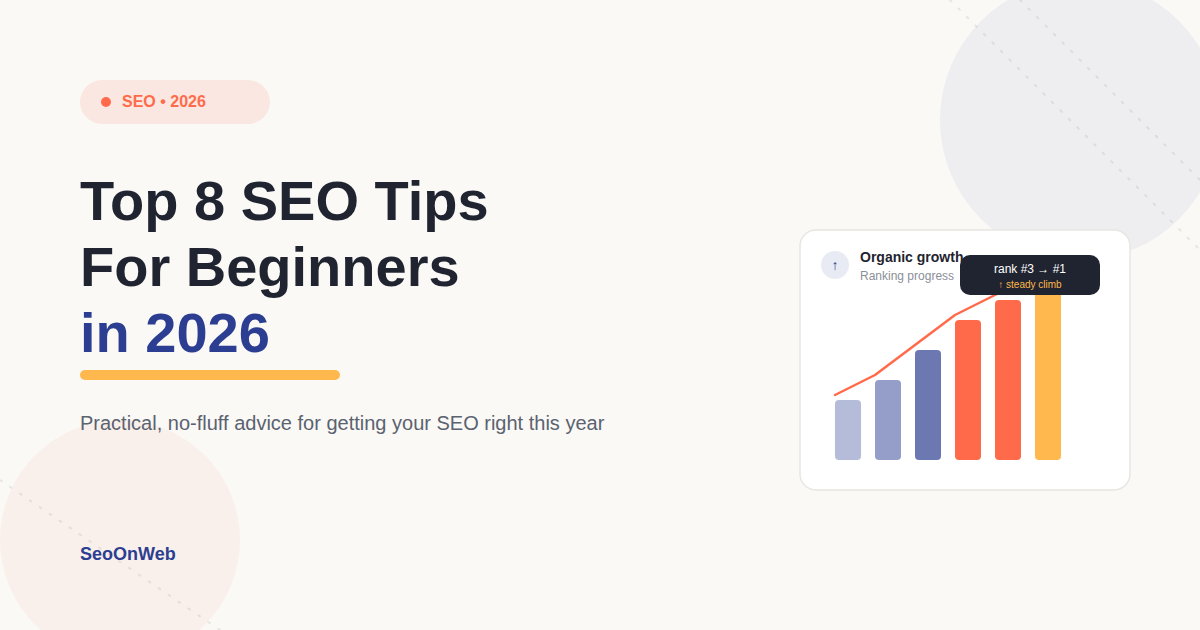
Table of contents
- 01What Is SEO and Why Does It Matter in 2026?
- 02Tip #1: Understand Search Intent Before Choosing Keywords
- 03Tip #2: Do Proper Keyword Research
- 04Tip #3: Write Helpful and Original Content
- 05Tip #4: Optimize Your On-Page SEO
- 06Tip #5: Learn Basic Technical SEO
- 07Tip #6: Build High-Quality Backlinks
- 08Tip #7: Focus on User Experience (UX)
- 09Tip #8: Track Performance and Keep Improving
- 10Common SEO Mistakes Beginners Should Avoid
- 11SEO Checklist for Beginners in 2026
- 12Essential SEO Tools Every Beginner Should Use
- 13Final Thoughts
- 14Frequently Asked Questions
If you've ever published a blog post, waited a week, and then Googled your own title just to see it nowhere on the first page — you're not alone. That's the moment most beginners realize that writing content and getting that content found are two completely different skills.
SEO in 2026 looks different than it did even two years ago. Google's AI Overviews now answer a huge share of searches directly on the results page. For the fuller picture of how Google's AI Overviews changed things in 2026, our algorithm update breakdown covers the specific changes and how to respond to them. which means your content has to be good enough to be pulled into those answers, not just ranked below them.
At the same time, the fundamentals haven't gone anywhere — Google still rewards pages that are genuinely useful, well-structured, and built around what a real person is trying to accomplish.
The problem is that most beginners either skip the fundamentals and chase shortcuts, or get overwhelmed by technical jargon and give up before they start. This guide is meant to sit in the middle: eight practical, beginner-friendly SEO tips that reflect how search actually works right now, without assuming you already know what a canonical tag is.
By the end, you'll know how to research keywords properly, structure a page Google can understand, avoid the mistakes that quietly tank most new websites, and set up a simple system for tracking whether any of it is working.
What Is SEO and Why Does It Matter in 2026?
SEO — search engine optimization — is the practice of shaping your website and content so that search engines can understand it, trust it, and show it to people looking for what you offer. Done well, it brings in organic traffic: visitors who find you through an unpaid Google search rather than an ad you paid for.
That distinction matters more than ever. Paid traffic disappears the moment you stop paying. Organic traffic, once built, keeps working for you in the background — a well-optimized page can bring in visitors for years with minimal upkeep.
What's changed in 2026 is where that traffic comes from. Google's AI Overviews now sit above the traditional blue links for a large share of queries, summarizing an answer pulled from a handful of trusted sources. Getting cited in one of those summaries can send a meaningful amount of traffic your way — but only if your content is structured clearly enough for Google's systems to extract an answer from it.
None of this replaces the basics. It just raises the bar for what "good content" needs to look like. Once you've got the fundamentals down, it's worth understanding how on-page, technical, and off-page SEO fit together as a complete system, not three separate to-do lists. Businesses that invest in SEO now are building an asset that compounds — every well-optimized page adds to the site's overall authority and makes the next page easier to rank.
Tip #1: Understand Search Intent Before Choosing Keywords
Search intent is the reason behind a search — what the person actually wants when they type those words into Google. Get this wrong, and it doesn't matter how well-written your content is; you're answering a question nobody asked.
There are four common types of intent:
Informational — the person wants to learn something ("what is technical SEO")
Commercial — they're comparing options before buying ("best SEO tools for small business")
Transactional — they're ready to act ("hire SEO consultant near me")
Navigational — they're looking for a specific site or brand ("Ahrefs login")
A classic beginner mistake is writing a how-to guide (informational) and targeting a keyword that's actually transactional — like ranking a blog post for "buy SEO software" instead of a product page. Before you write a single word, search your target keyword yourself and look at what's already ranking. If the results are all product pages, Google has already told you the intent — and a blog post won't out-rank them no matter how well it's written.
Tip #2: Do Proper Keyword Research
Keyword research is how you find out what people are actually typing into Google — instead of guessing. The goal isn't to find the single "best" keyword; it's to build a realistic map of the terms your audience uses, at different stages of what they need.
Beginners often chase high-volume keywords and ignore everything else. In practice, long-tail keywords — longer, more specific phrases like "SEO tips for small ecommerce stores" instead of just "SEO tips" — tend to have lower competition and higher intent, making them far easier to rank for early on.
A few things worth understanding as you research:
Term | What It Means | Why It Matters |
Search Volume | How many people search a term per month | Signals demand, but not the whole picture |
Keyword Difficulty | How hard it is to rank for that term | Helps you avoid competing with sites far bigger than yours |
Long-Tail Keywords | Longer, specific search phrases | Easier to rank for, often higher intent |
You don't need expensive software to get started. Google Keyword Planner and Google Autocomplete (just start typing a topic into the search bar and see what Google suggests) are free and genuinely useful. For the complete free workflow, including Reddit and Quora mining and building topic clusters, see our guide to doing this without paying for a tool. As your site grows, tools like Ahrefs, SEMrush, and Ubersuggest give you deeper data on competition and difficulty.
Great SEO isn't about tricks — it's about being genuinely useful, and making sure Google can tell.
Tip #3: Write Helpful and Original Content
Google has been explicit for years now: content should be created for people first, search engines second. This is the core of what Google calls helpful content, and it overlaps heavily with E-E-A-T — Experience, Expertise, Authoritativeness, and Trustworthiness — the framework Google's own quality guidelines use to judge whether content deserves to rank.
In practice, that means your content should genuinely solve the problem someone came to solve, reflect real experience or knowledge rather than a rehashed summary of other articles, and get updated as things change instead of sitting stale for years.
It also means being careful with AI-generated content. Using AI as a starting point isn't the issue — publishing unedited, generic AI output at scale, with no real insight added, is exactly the kind of "content spam" Google has cracked down on. If a page reads like it could apply to any topic, it's probably not helpful enough to rank.
A quick beginner content checklist:
✅ Clear, descriptive headings
✅ Short paragraphs (2–4 sentences)
✅ At least one table or visual breakdown
✅ Relevant, original images
✅ An FAQ section addressing real follow-up questions
✅ A clear call to action
Tip #4: Optimize Your On-Page SEO
On-page SEO covers everything on the page itself that helps search engines understand what it's about.
Title Tag — the clickable headline shown in search results. Keep your main keyword near the front and make it something a human would actually click.
Meta Description — the short summary under the title tag. It doesn't directly boost rankings, but a compelling one improves your click-through rate, which matters just as much.
URL Structure — short, readable, and keyword-relevant. /seo-tips-beginners beats /post?id=48291 every time.
Heading Structure (H1–H3) — one H1 per page (your main title), with H2s and H3s organizing the content logically underneath, the way this article is structured.
Image Alt Text — a short written description of each image. It helps visually impaired users navigating with screen readers, and helps Google understand image content for search.
Internal Linking — linking to other relevant pages on your own site. It helps visitors discover more content and helps Google understand how your site's pages relate to each other.
Tip #5: Learn Basic Technical SEO
Technical SEO sounds intimidating, but at the beginner level it really just means making sure Google can properly find, load, and understand your site.
An XML sitemap is a file that lists all your important pages, essentially handing Google a map of your site. A robots.txt file tells search engines which pages they should or shouldn't crawl. Canonical tags tell Google which version of a page is the "main" one when duplicate or similar content exists. 301 redirects send visitors and search engines from an old URL to a new one, so you don't lose value when a page moves.
Beyond that, mobile-friendliness and HTTPS (a secure connection) are now baseline expectations rather than bonuses. And Core Web Vitals — Google's metrics for loading speed, visual stability, and interactivity — directly affect both rankings and user experience.
Common technical SEO mistakes to avoid:
No sitemap submitted to Google Search Console
Blocking important pages in robots.txt by accident
Duplicate pages competing against each other with no canonical tag
Slow-loading images dragging down Core Web Vitals
A site that isn't mobile-responsive
Consistency beats cleverness. Publish, measure, refine, repeat — that's the whole game.
Tip #6: Build High-Quality Backlinks
A backlink is a link from another website pointing to yours. Google treats backlinks as a vote of trust — the more relevant, reputable sites that link to you, the more authority your site tends to build.
Some beginner-friendly, legitimate ways to earn backlinks:
Guest posting on relevant blogs in your niche
Niche edits — getting your link added to existing, relevant articles
HARO/Digital PR — responding to journalist queries with expert quotes
Business directories relevant to your industry
Social profiles that link back to your site
What to avoid entirely: buying spam backlinks, using PBNs (private blog networks built purely to manipulate rankings), or joining link farms. These tactics might work briefly, but they carry real risk of a Google penalty — and rebuilding trust after that is far harder than earning it the slow way.
Tip #7: Focus on User Experience (UX)
Google increasingly treats user experience as an SEO signal in its own right, because a page that frustrates visitors is a page Google shouldn't be recommending.
That means thinking about mobile optimization (most searches now happen on phones), easy navigation (can someone find what they need in a couple of clicks?), fast loading speed, readability (short paragraphs, plain language, enough white space), and clear CTA placement so visitors know what to do next.
None of this is exotic. It's the difference between a site that feels considered and one that feels thrown together — and Google's ranking systems are increasingly good at telling the two apart.
Tip #8: Track Performance and Keep Improving
SEO isn't a one-time setup — it's a loop of publishing, measuring, and adjusting.
Essential tools for beginners:
Tool | What It's For | Cost |
Google Search Console | Tracks clicks, impressions, rankings, indexing | Free |
Google Analytics 4 | Tracks visitor behavior on your site | Free |
Bing Webmaster Tools | Same idea, for Bing/Microsoft search | Free |
Keep an eye on clicks (how many people actually visited from search), impressions (how often you appeared in results), CTR (click-through rate — clicks divided by impressions), rankings (your position for target keywords), and indexed pages (how many of your pages Google has actually stored and can show).
If a page has plenty of impressions but a low CTR, the content may be ranking fine but the title or meta description isn't compelling enough to earn the click. If rankings are dropping for a page that used to perform, it's often a sign the content needs an update.
Common SEO Mistakes Beginners Should Avoid
A quick gut-check list before you hit publish:
Keyword stuffing (repeating a keyword unnaturally instead of writing normally)
Duplicate content across multiple pages
Ignoring technical SEO entirely
Buying backlinks
Publishing thin, surface-level content
Skipping internal links
Missing or poorly written meta tags
A slow-loading website
SEO Checklist for Beginners in 2026
Save this and run through it before publishing anything new:
✅ Keyword research completed
✅ Search intent confirmed
✅ Optimized, readable URL
✅ Compelling meta title
✅ Compelling meta description
✅ One clear H1
✅ Internal links added
✅ Image alt text written
✅ Schema markup added where relevant — see our step-by-step schema markup guide if you haven't done this yet
✅ Sitemap updated
✅ Page speed checked
✅ Mobile-friendly confirmed
Essential SEO Tools Every Beginner Should Use
Free Tools | Paid Tools |
Google Search Console | Ahrefs |
Google Analytics | SEMrush |
Google Keyword Planner | Moz |
Bing Webmaster Tools | Screaming Frog |
Google Trends | Surfer SEO |
Start with the free tools. They're genuinely capable, and there's little reason to pay for anything until you've outgrown what they offer.
Final Thoughts
SEO is a long-term strategy, not a quick trick — and that's actually good news. It means consistent, honest effort compounds over time, and there's no shortcut that skips past doing the fundamentals well.
Focus on your users first, learn the fundamentals covered here, apply them consistently, and keep an eye on how Google's systems — including AI-powered search — continue to evolve. Everything else follows from that.
Ready to Start Your SEO Journey?
📥 Download a Beginner SEO Checklist
🔍 Get a Free Website SEO Audit
💬 Contact Our SEO Experts
📚 Explore More SEO Guides
Frequently Asked Questions
What is SEO?
Is SEO difficult for beginners?
How long does SEO take to show results?
What is the best free SEO tool?
Is keyword research important?
Can I learn SEO without coding?
What are the three pillars of SEO?
How many keywords should one page target?
Is AI replacing SEO?
How often should I update my content?
What is the difference between On-Page and Technical SEO?
Can beginners rank on Google?
More from the blog
All posts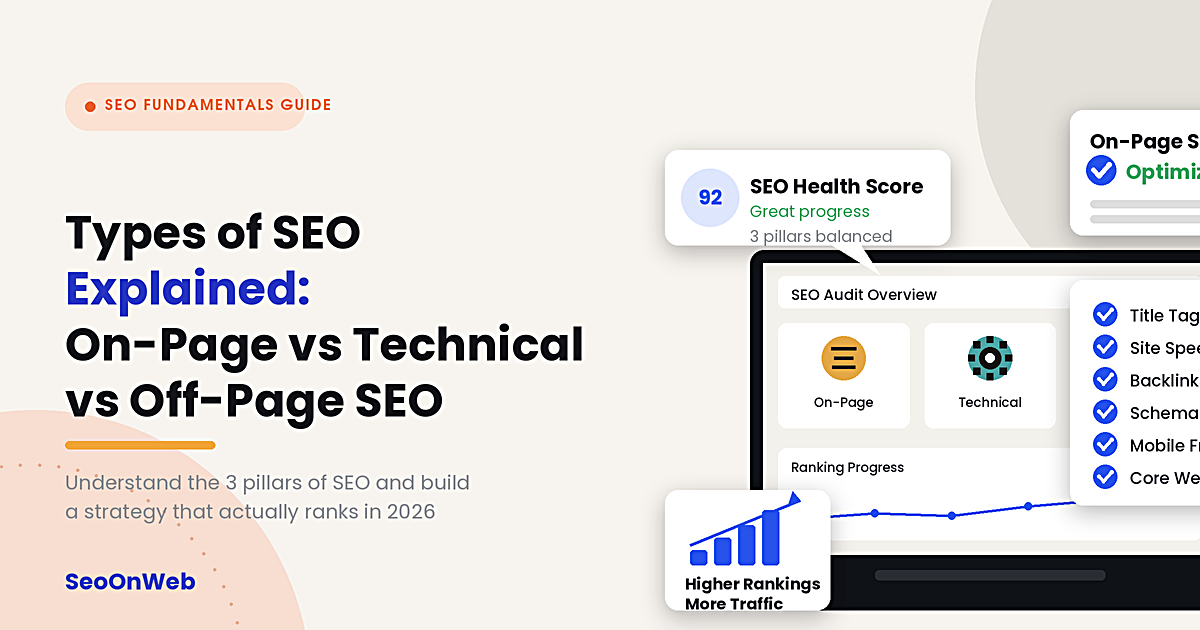
Types of SEO Explained: On-Page vs Technical vs Off-Page SEO in 2026
Confused by the types of SEO? Learn on-page vs off-page SEO, technical SEO checklist, and which to prioritise in 2026 for better rankings and AI search visibility.
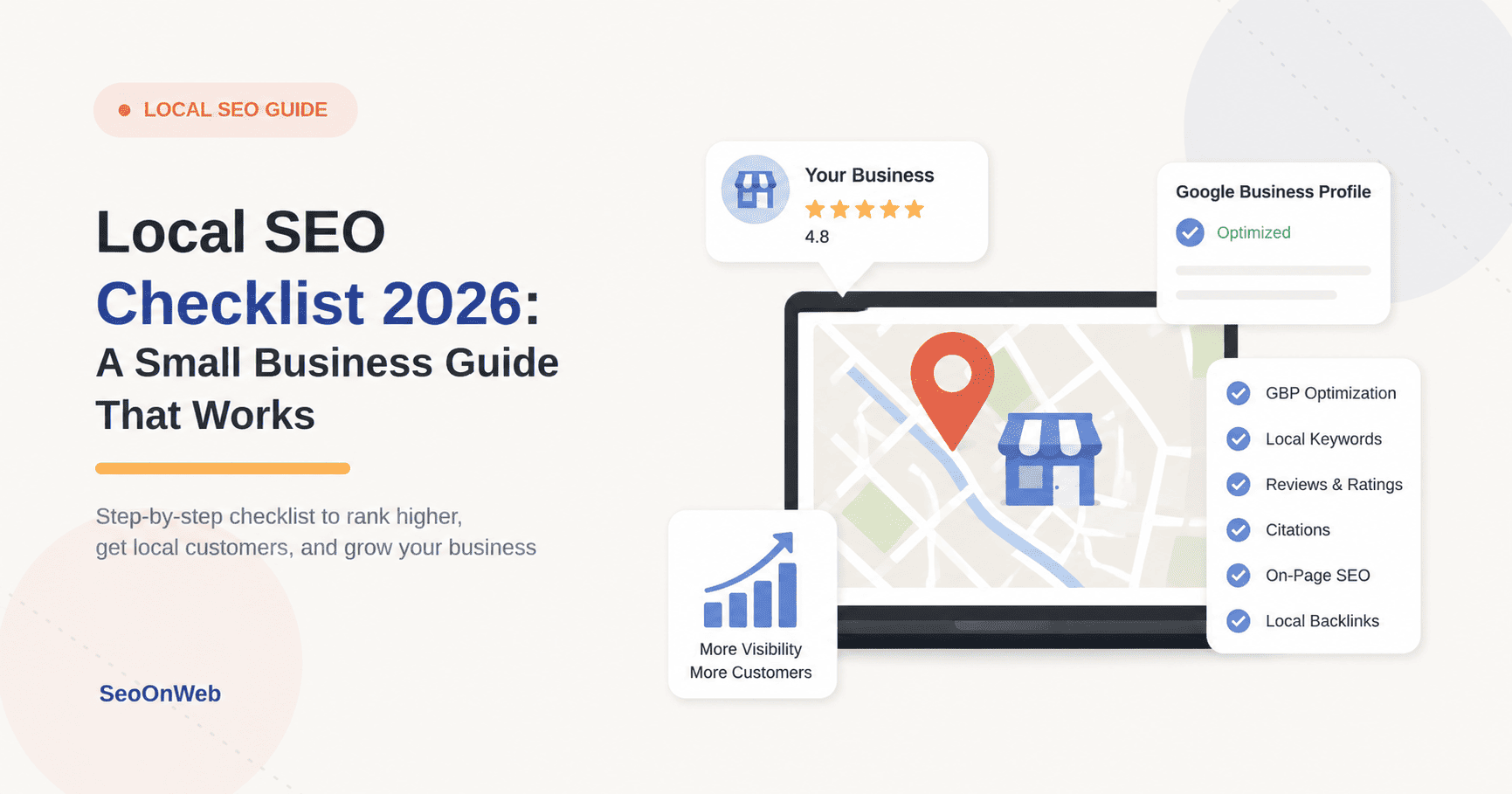
Local SEO Checklist for Small Businesses
Follow this 2026 local SEO checklist to optimize your Google Business Profile, build citations, earn reviews, and rank higher on Google Maps.
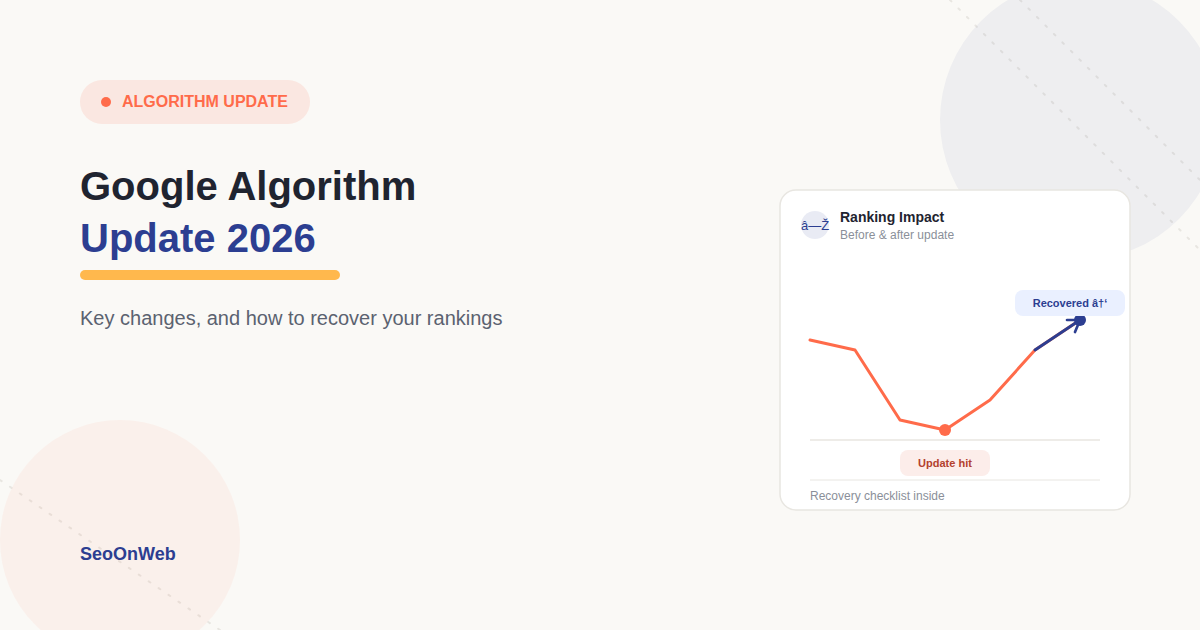
Google Algorithm Update 2026: Key Changes & Recovery Tips
Discover what changed in the Google algorithm update 2026 and how to recover rankings after a drop. Core updates, spam updates, and a practical SEO recovery checklist.
Let's talk
Ready to grow with SEO that actually works?
Book a free 30-minute strategy call and we'll walk through your site, your goals, and the shortest path to real results.

Written by
Deepak Sengar
SEO Expert · Founder, SeoOnWeb
Deepak Sengar is an SEO specialist with 3+ years of experience across on-page SEO, technical SEO, AI Search Optimization (AIO), Answer Engine Optimization (AEO), Generative Engine Optimization (GEO), keyword research, and content optimization. He holds a Bachelor of Business Administration (BBA) from Bundelkhand University. He most recently worked as an SEO Executive at College Drishti, a Delhi-based education consultancy, from July 2025 to May 2026, where he led SEO strategy to grow organic visibility and traffic for undergraduate (UG) and postgraduate (PG) admissions content. Today, through SeoOnWeb, he helps businesses build ranking strategies rooted in the same on-page, technical, and off-page fundamentals.
More about Deepak